 By Luobinsen
  Publish date: November 21, 2025
  Read time: 3 minutes
 Updated October 14, 2026.
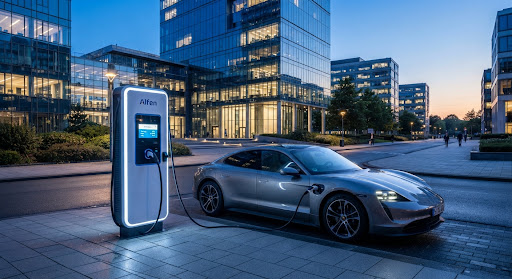
Battery storage can support EV charging at sites where demand arrives in short bursts or the available grid connection is limited. It stores energy for later use, allowing a charging site to manage when it draws electricity from the grid. Whether it is worthwhile depends on the charging schedule, electricity tariff, available space and total project cost.
How battery storage supports EV charging
A battery energy storage system, or BESS, works alongside the charging equipment and site controls. It can charge when spare electrical capacity is available and discharge when vehicle demand exceeds the planned grid draw. Depending on the system design, vehicles may receive power from the grid, storage or both; a battery does not need to supply every charging session.
Storage can bridge a temporary power gap. It cannot compensate indefinitely for a site that consumes more energy than its grid connection and any on-site generation can replenish. Consecutive busy periods and the time available to recharge the stationary battery therefore matter as much as the peak charger rating.
Separate power from energy capacity
- Power, measured in kW: the rate at which a system can deliver or absorb energy.
- Energy capacity, measured in kWh: the amount of energy stored. Usable capacity can differ from the battery’s nominal rating.
- Duration: how long the available energy can support a particular load, subject to power limits and operating conditions.
For a simplified planning example, suppose charging demand exceeds the available grid supply by 100 kW for half an hour. That gap represents 50 kWh. This is an energy balance, not a battery sizing recommendation: the design must also allow for conversion losses, auxiliary loads, operating reserve, degradation and the battery’s permitted discharge range.
Evaluate electricity costs with the actual tariff
Time-of-use energy prices charge for electricity consumed in kWh at different times. Demand charges, where applicable, charge for a measured power level in kW under the utility’s billing rules. They are different costs. Moving energy to a cheaper period and reducing a billing peak should be assessed separately.
Use the site’s interval load profile and tariff to compare a baseline with a storage-assisted design. Include the cost of recharging the battery, efficiency losses, equipment, installation, software, maintenance and eventual replacement. A tariff difference alone is not a net-savings calculation, and storage does not guarantee a particular payback period. Compare managed charging and a grid upgrade as alternative or complementary approaches.
Plan solar integration and outage operation separately
Solar generation can contribute energy when its production aligns with site needs; storage can shift some of that energy to another time. The design still needs to account for seasonal generation, charging demand and the ability to recharge the battery.
A battery does not automatically keep chargers operating during an outage. Backup operation requires a system designed and configured for that purpose, including appropriate protection and controls. Available stored energy and supported loads limit how long it can operate.
Prepare a useful project brief
Before selecting equipment, record the vehicle mix, expected arrivals, energy required per session, simultaneous charging demand, site connection capacity and tariff. Define whether the primary objective is peak management, supporting a constrained connection, solar integration or resilience. Then assess the complete charging and storage system with the relevant suppliers and site professionals.
Explore the Luobinsen charging product range with these requirements in mind. Confirm the selected charger’s operating range, control interfaces and integration responsibilities before committing to a storage-assisted project.
Technical references: Battery Energy Storage for Electric Vehicle Charging Stations; Grid-Scale Battery Storage: Frequently Asked Questions.